Reversible Bistable Platform
A new approach
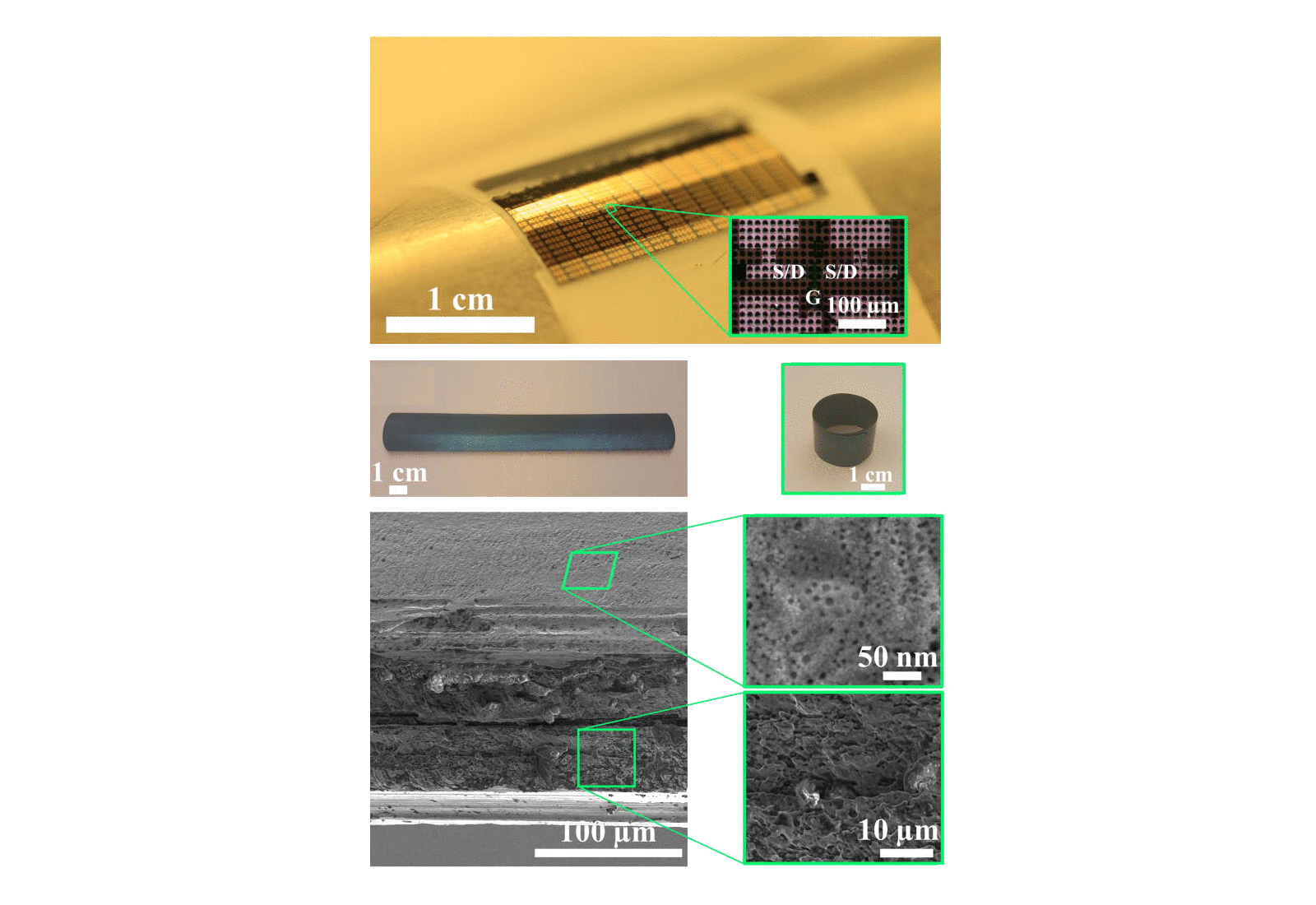
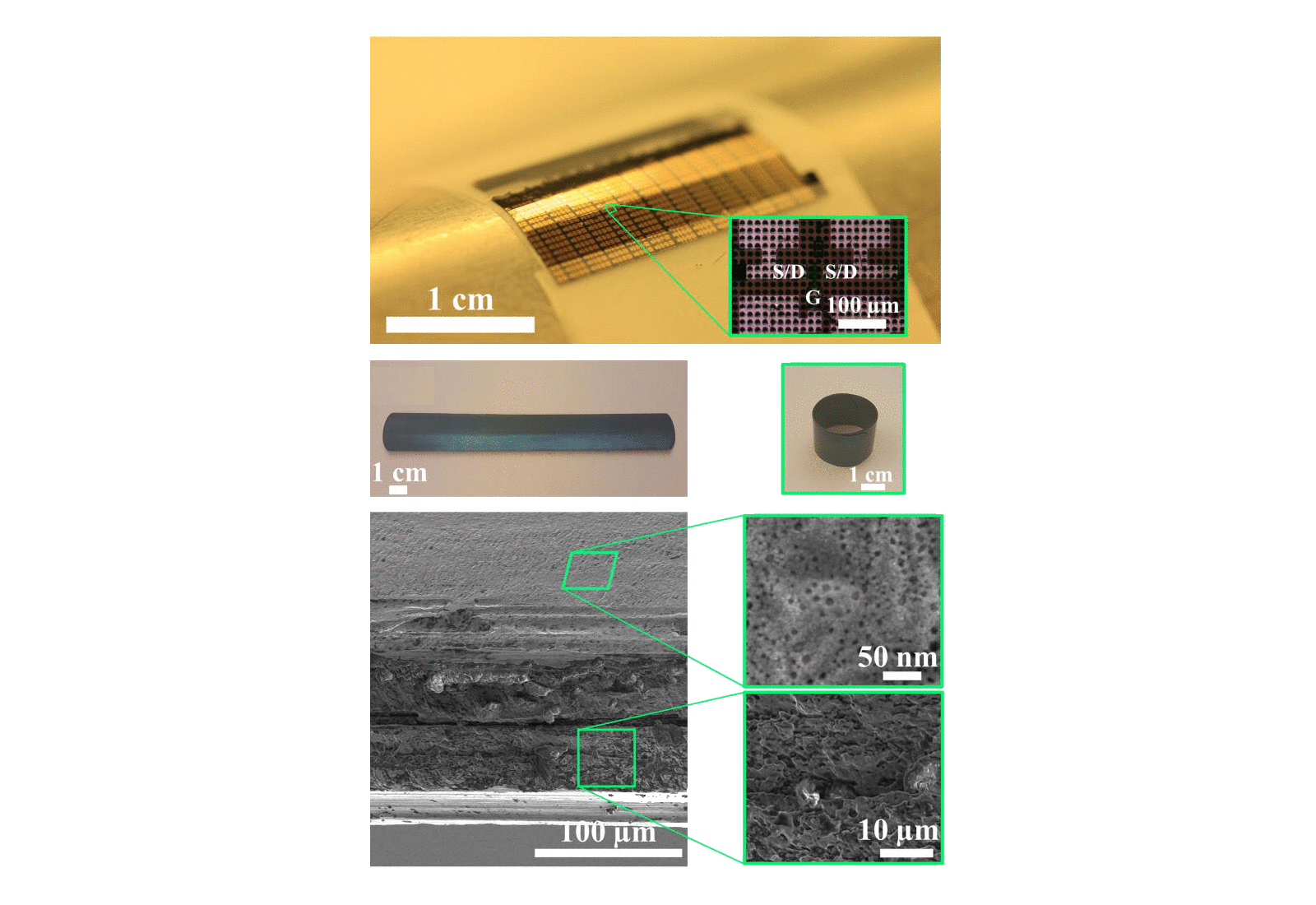
Flexibility can bring a new dimension to state-of-the-art electronics, such as rollable displays and integrated circuit systems being transformed into more powerful resources. Flexible electronics are typically hosted on polymeric substrates. Such substrates can be bent and rolled up, but cannot be independently fixed at the rigid position necessary to realize rollable display-integrated gadgets and electronics. The reversibly bistable material can assume two stable states in a reversible way: flexibly rolled state and independently unbent state. Such materials are used in cycling and biking safety wristbands and a variety of ankle bracelets for orthopedic healthcare. They are often wrapped around an object with high impulsive force loading. Here, we study the effects of cumulative impulsive force loading on thinned (25 μm) flexible silicon-based n-channel metal– oxide–semiconductor field-effect transistor devices housed on a reversibly bistable flexible platform.
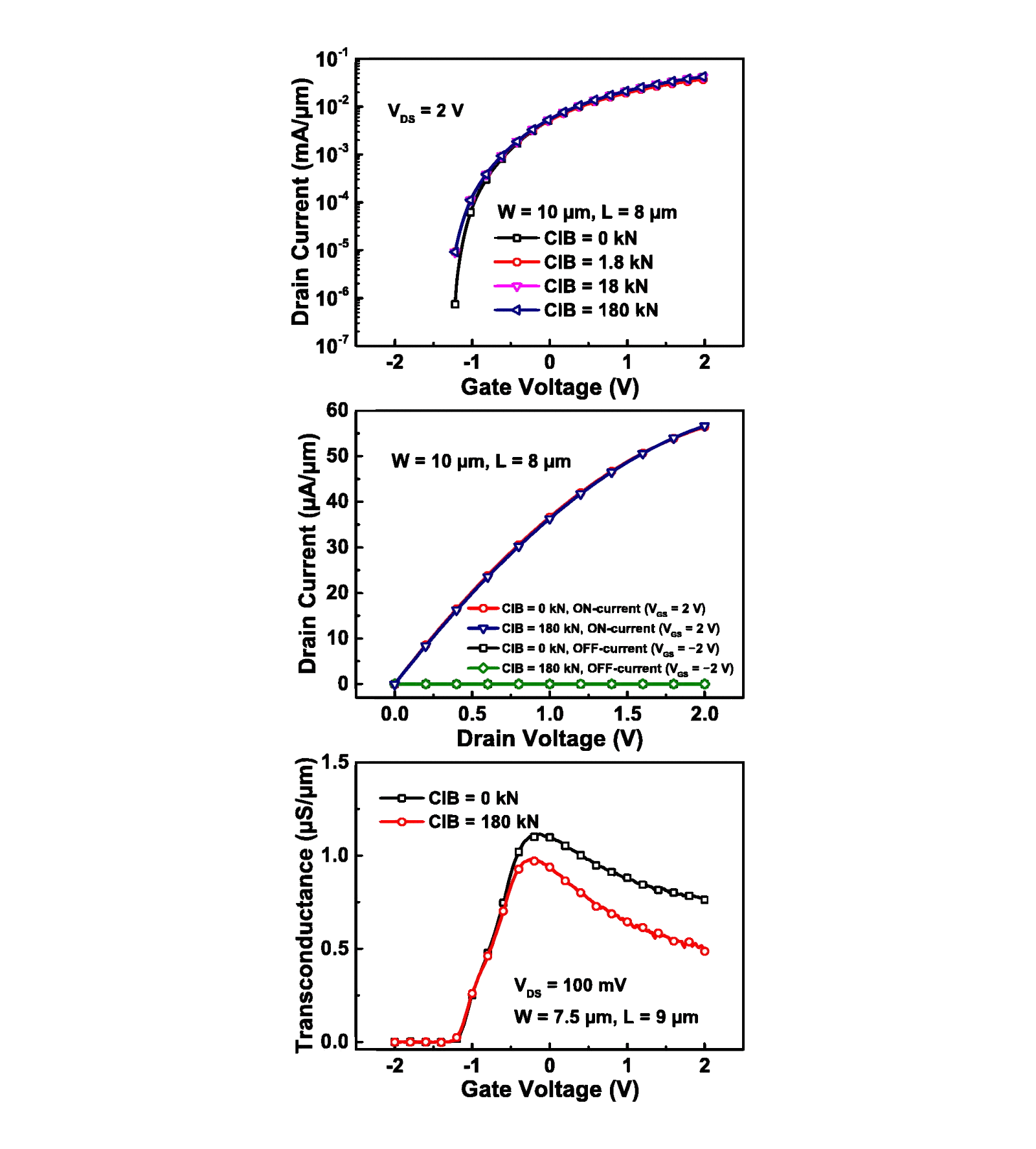
We found that the transistors have maintained their high performance level up to an accumulated 180 kN of impact force loading. The gate dielectric layers have maintained their reliability, which is evidenced by the low leakage current densities. Also, we observed low variation in the effective electron mobility values, which manifests that the device channels have maintained their carrier transport properties.
“We have developed a smart reversibly bistable wristband integrated with state-of-the-art flexible silicon electronics.”
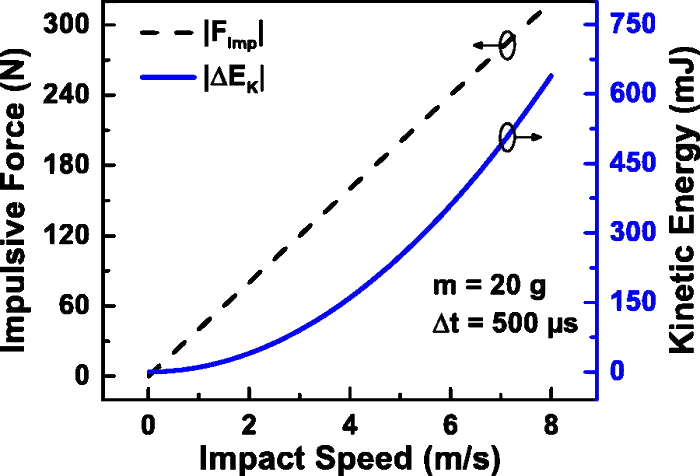
We have introduced a host material for flexible electronics, a platform that is mechanically flexible and reversibly bistable. We have also introduced a performance metric, namely, the cumulative impact budget, which takes into account the impact force imparting an impulse on the silicon fabric during the mechanical deformation of the substrate. Moreover, we have shown that the MOSFET devices on the 25-μm-thick silicon fabric have generally maintained their high performance level after accumulating impulsive force budgets of 180 kN. The use of soft materials as adhesion layers helped in mitigating the applied stress during each impact cycle. Minimal variations transistor parameter values indicate that the devices have maintained their operational stability. The only significant performance degradation is the reduction in the sharpness of switching.
So where to from here then?
We conclude that successive application of impulsive forces has caused more trapped charges at the oxide–channel interfaces, resulting in reductions in COX values and increasing the ratio of the depletion capacitance to the oxide layer capacitance (CD/COX). These platforms can be extended in the future to smart electronics integrated reversible multistable systems, wherein multiple different shapes can be acquired by the electronic system by mechanical or electrical actuation.
Drop on in
4700 KAUST, Ibn Sina Building (3),
Thuwal, Makkah
Saudi Arabia, 23955-6900
Give us a call
Office: +966-2-808-4450
Lab Phone: +966-2-808-0797
Contact online
Email: MuhammadMustafa.Hussain@kaust.edu.sa
INL: nanotechnology.kaust.edu.sa