Reliability of Free Form Electronics
A new approach
Our lives have been greatly affected by technology. It is not that we become more dependent on electronic systems but rather we rely more on them and delegate tasks that can facilitate our lives and improve its quality. This would not have been the case if the devices we rely on are unreliable. Hence, reliability is paramount when discussing a new era of free-form electronics and the way they will interact with their novel environments. The futuristic vision culminating in the near future about the internet of things (IoT) and internet of everything (IoE) (where humans are also connected not only “things”) makes it essential to study the properties of the new IoT/IoE devices and their operation environments. As these issues shape up, the next challenge is to address the question whether these devices operating in their environments are reliable and if the answer is yes, for how long? When will they need replacement/upgrading? To target these challenges new reliability concerns arise.
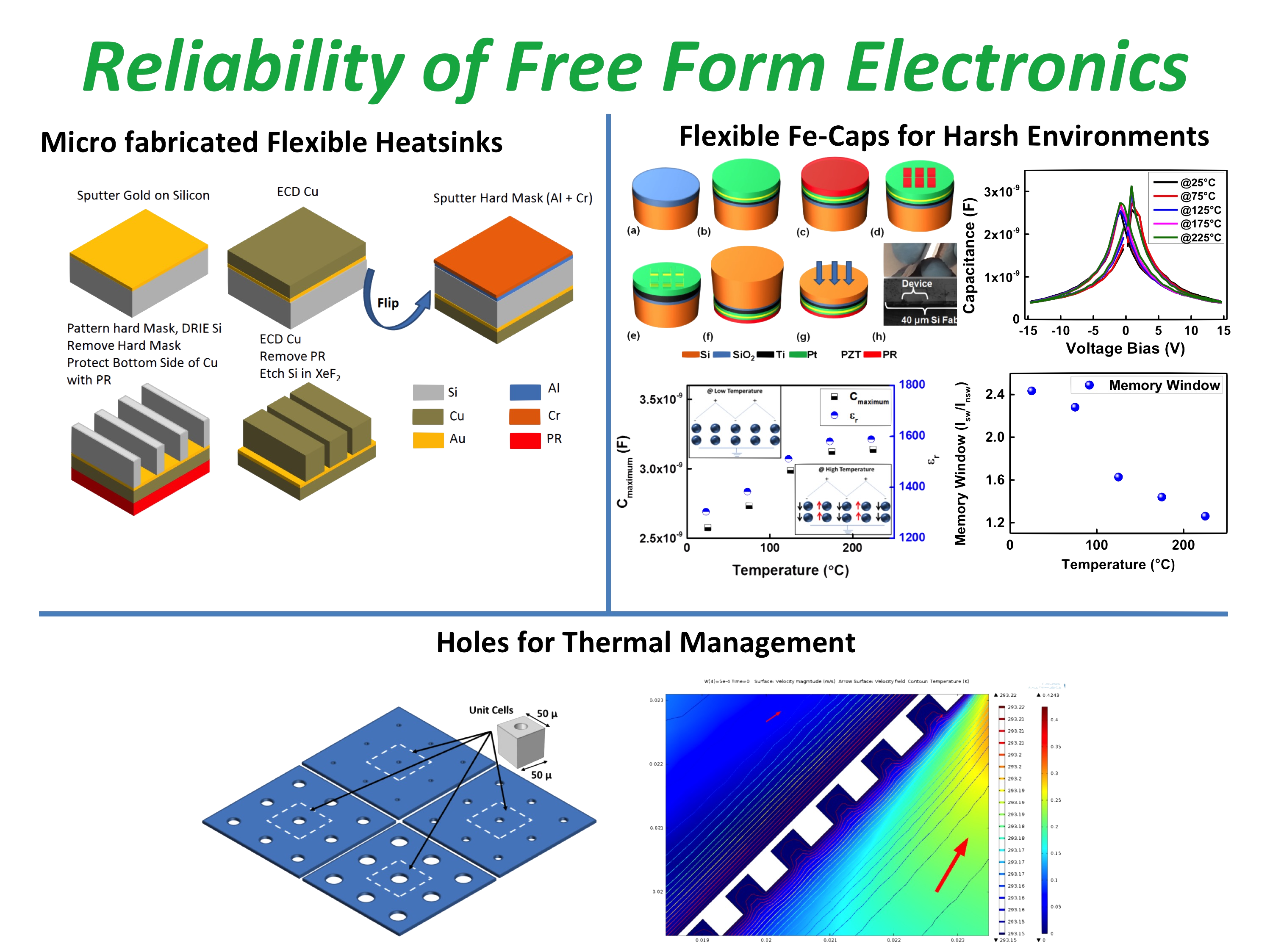
For instance, an IoE device that needs to be worn around the finger of a human being needs to be able to survive a bending radius of few millimeters reliably. Although the electronic components themselves can heat up to above 80˚C, human skin loses comfort once the temperature of the system exceeds the 37 ˚C benchmark. Therefore, the system not only needs to have sufficient heat dissipation and thermal management system that matches that of today’s traditional devices, it also needs to remain lightweight, flexible, with a more efficient cooling mechanism to keep up with the lower temperature limit. Another example is a stretchable system that can be wrapped around movable objects or body joints. This imposes a different set of reliability specifications than a system that is permanently bent in a static fashion. Our results showed that dynamic stress has a severer effect on electronics than continuous static stress.
“We have studied the unexplored reliability aspects from a mechanical and electrical perspective of free-form electronics (flexible, stretchable, reconfigurable, and destructible).”
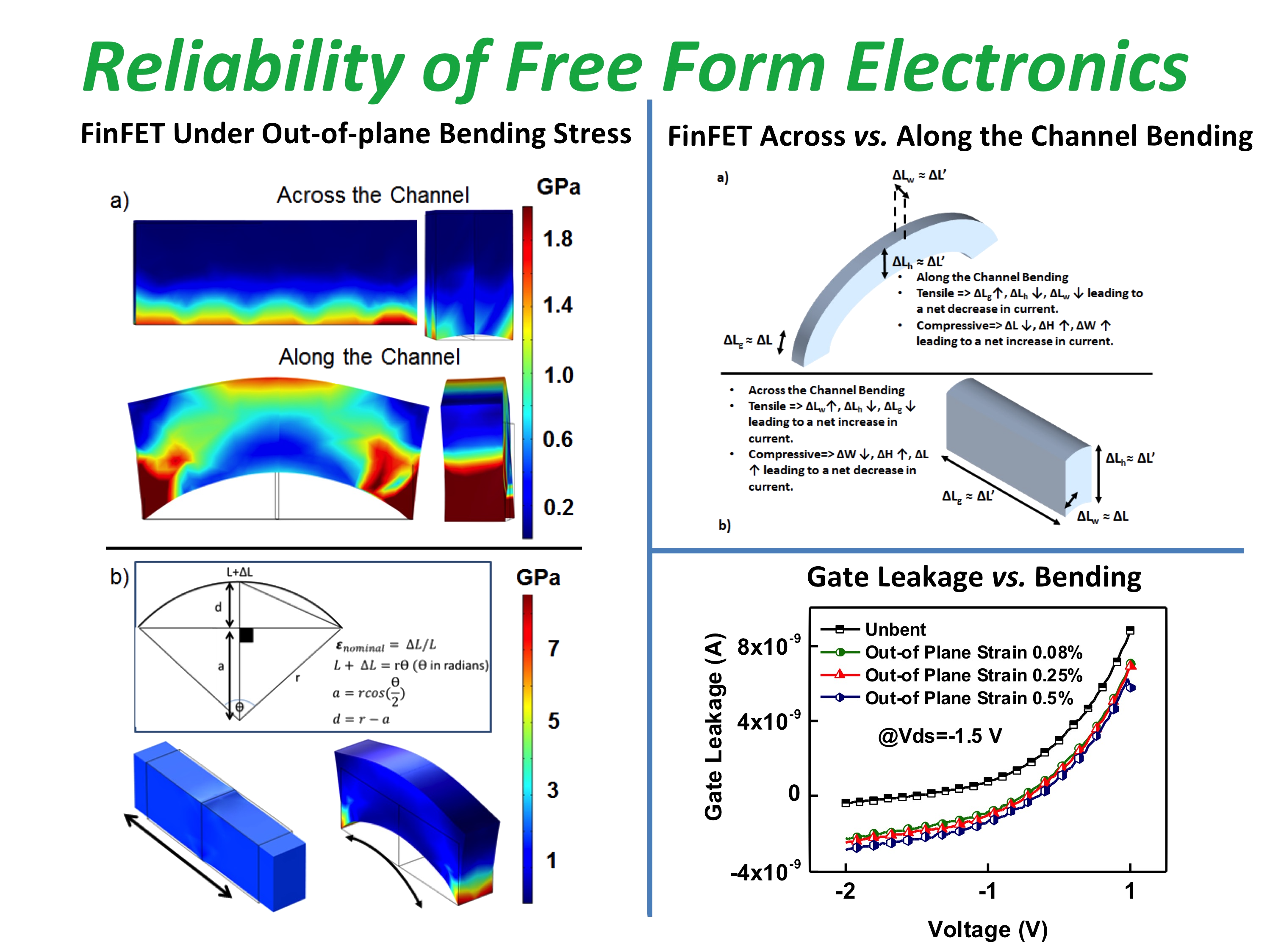
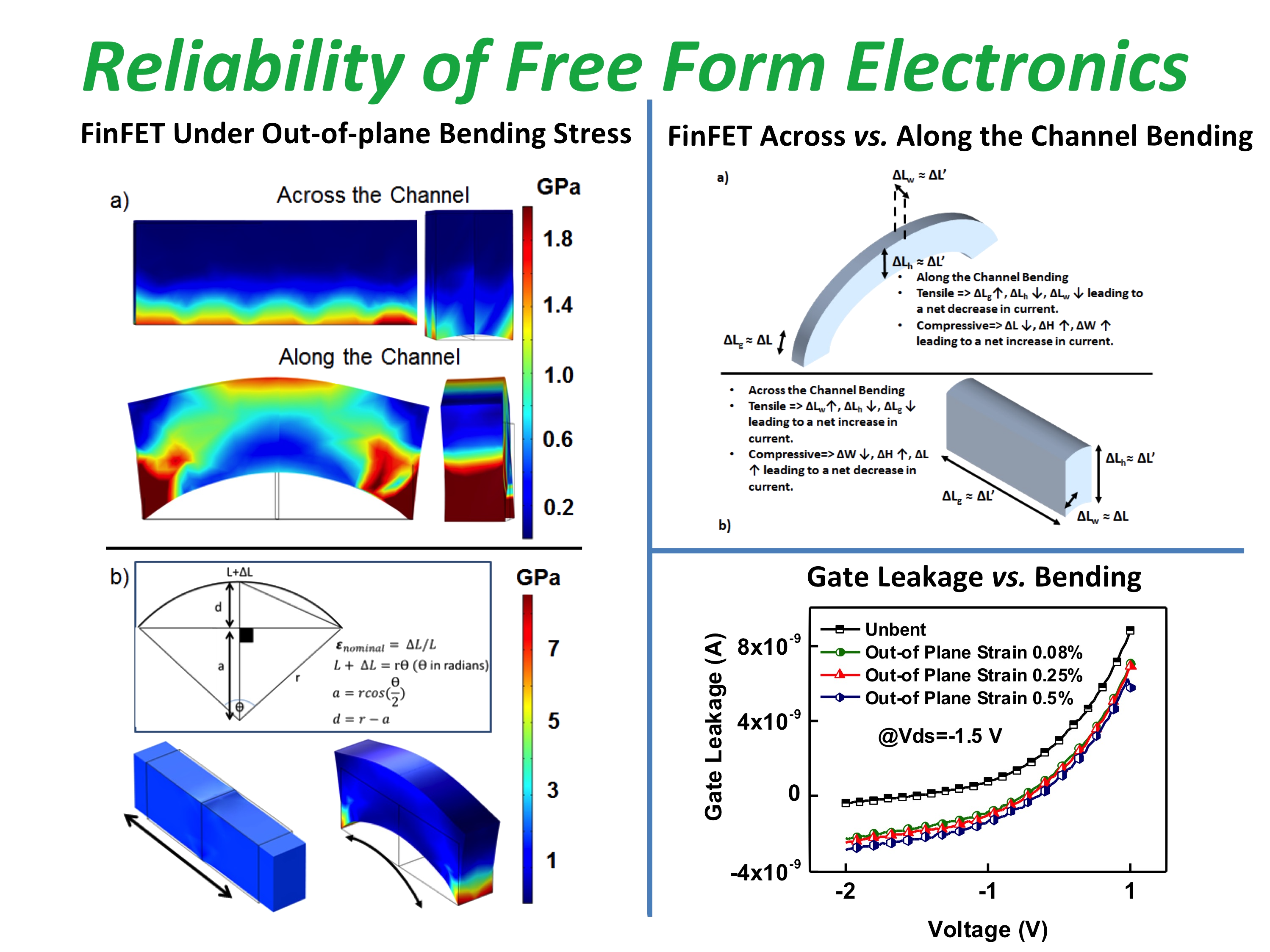
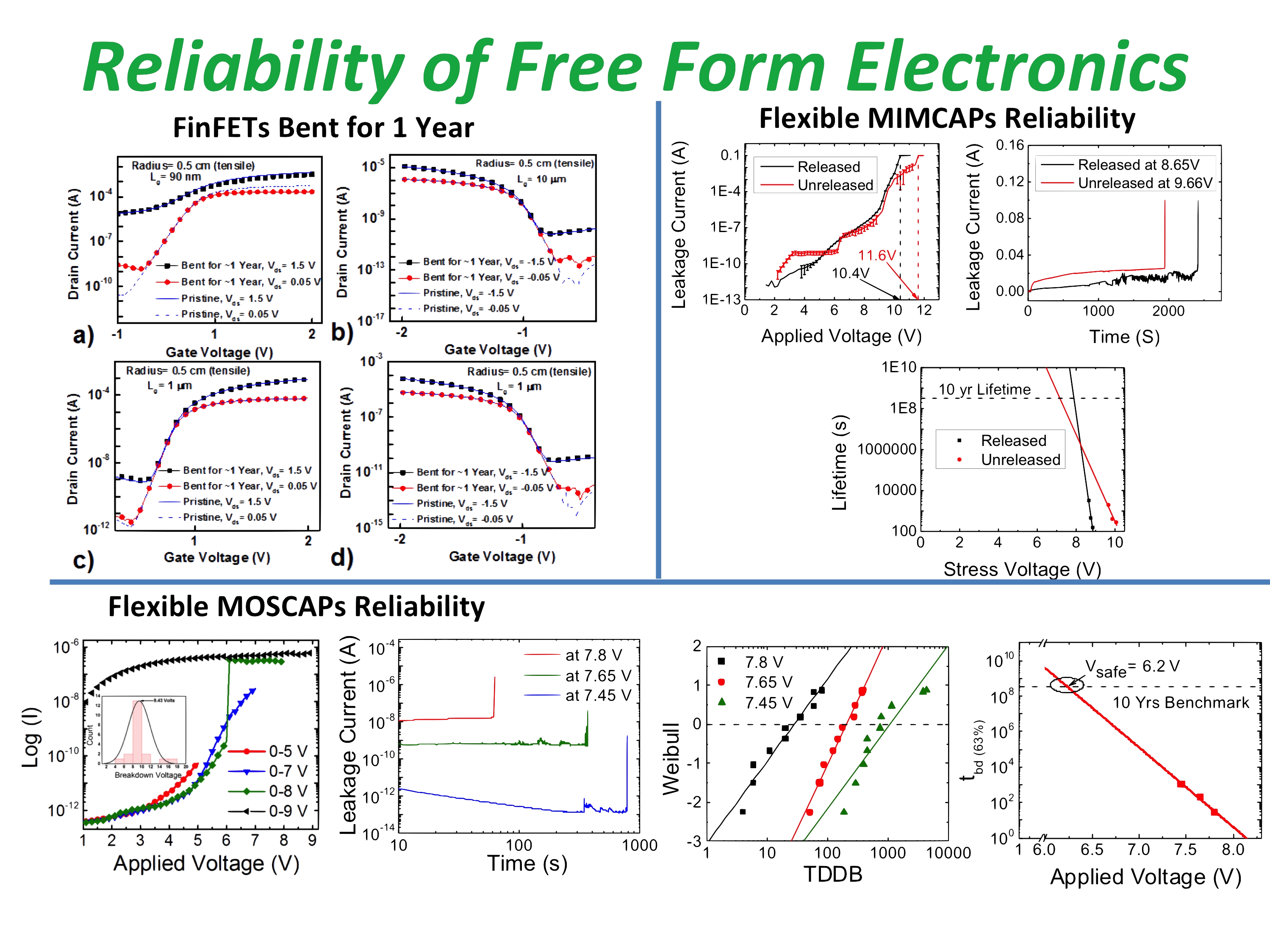
We focus on studying the traditional accelerated tests for reliability assessment and lifetime projections on flexible devices as well as the new reliability aspects related to mechanical stress. This is not an easy challenge because of the entangled nature of the mechanical and electrical stress when both are in effect for a bent device under normal operation. So far we have studied the electrical reliability of flexible MIMCAPs and MOSCAPs using etch-protect-release approach and assessed the degradation in lifetime projections due to the presence of the release trenches. We have also studied the endurance of flexible PZT based Ferroelectric capacitors under various bending conditions and assessed their performance in harsh environment (endurance under mechanical stress imposed by bending and thermal stress due to high temperatures). We have also studied the out-of-plane bending stress effect on FinFETs and how it affects its functionality.
So where to from here then?
The results of the studies showed mild degradation in some devices. The assessment of this degradation can help system designers design efficient free-form electronic systems that are suitable for IoT/IoE applications while preserving the reliability degree we enjoy in today’s traditional reliable electronic systems. Future work would aim at drawing full mechanical accelerated tests analogies to the well-established electrical accelerated tests for electronic systems. Also extending the work to studies of interconnects, 3D integrated systems, and novel material systems for flexible electronics is a very appealing and needed direction.
Drop on in
4700 KAUST, Ibn Sina Building (3),
Thuwal, Makkah
Saudi Arabia, 23955-6900
Give us a call
Office: +966-2-808-4450
Lab Phone: +966-2-808-0797
Contact online
Email: MuhammadMustafa.Hussain@kaust.edu.sa
INL: nanotechnology.kaust.edu.sa