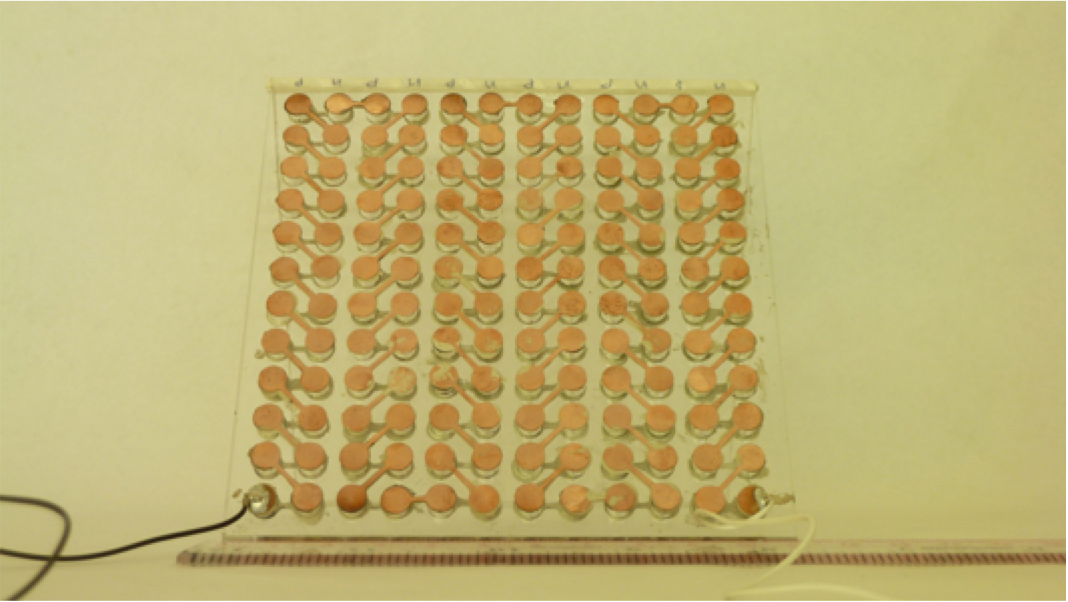
Thermoelectric Generators
A new approach
While we are interested about reliable and efficient ways of energy harvesting, we have particular interest about thermoelectric generators (TEGs) due to its clean and quiet nature of operation and its potential wide ranging applicability. For nearly a century, the research focus in the general area of thermoelectricity has been geared toward thermoelectric materials. Having higher Seebeck coefficient, higher electrical conductivity and lower thermal conductivity are the central goal of such activities.
However, higher electrical conductivity and lower thermal conductivity is a paradoxical challenge. While such problems can be better solved using materials and chemistry related fundamental scientific exploration, we have particularly focused on the architecture of the TEGs. Over the course of last five years, we have demonstrated various toolboxes to dynamically tune the distance between hot and cold end of a TEG system. We have demonstrated flexible silicon based TEGs to fundamentally eliminate challenges associated with flexibility and low thermal budget processes to obtain high quality thermoelectric materials (Small 2013). Recently we have demonstrated stretchable TEGs in pursuit of efficiently harvesting the highest possible thermoelectric energy (Nano Energy 2016).

“Thermoelectric Generators windows show a great potential in future self-sustainable buildings.”
By using low cost accessible recyclable materials like papers we have demonstrated an Origami architecture paper TEG can provide a low-cost solution for energy harvesting (Nano Energy 2016). Additionally, by transforming 2D thermoelectric thin films into 3D tubular architecture TEG, area efficiency can be achieved with out-of-plane arrangement of hot and cold end to eliminate near vicinity heat convection related efficiency drop out issue. Our passion toward innovative application has lead us toward thermoelectric power generation from the backplane of laptops and feed that power back to the system to operate nearly 15% of the transistors in an advanced microprocessor.
So where to from here then?
We were awarded DOW Sustainability Innovation Challenge Award 2012 for demonstrating world’s first ever thermoelectric windows which can generate 320 Watts of power from 100 ft2 area in a hot or cold climatic area where the temperature difference between inside a building and outside environment is 20 °C.
Drop on in
4700 KAUST, Ibn Sina Building (3),
Thuwal, Makkah
Saudi Arabia, 23955-6900
Give us a call
Office: +966-2-808-4450
Lab Phone: +966-2-808-0797
Contact online
Email: MuhammadMustafa.Hussain@kaust.edu.sa
INL: nanotechnology.kaust.edu.sa